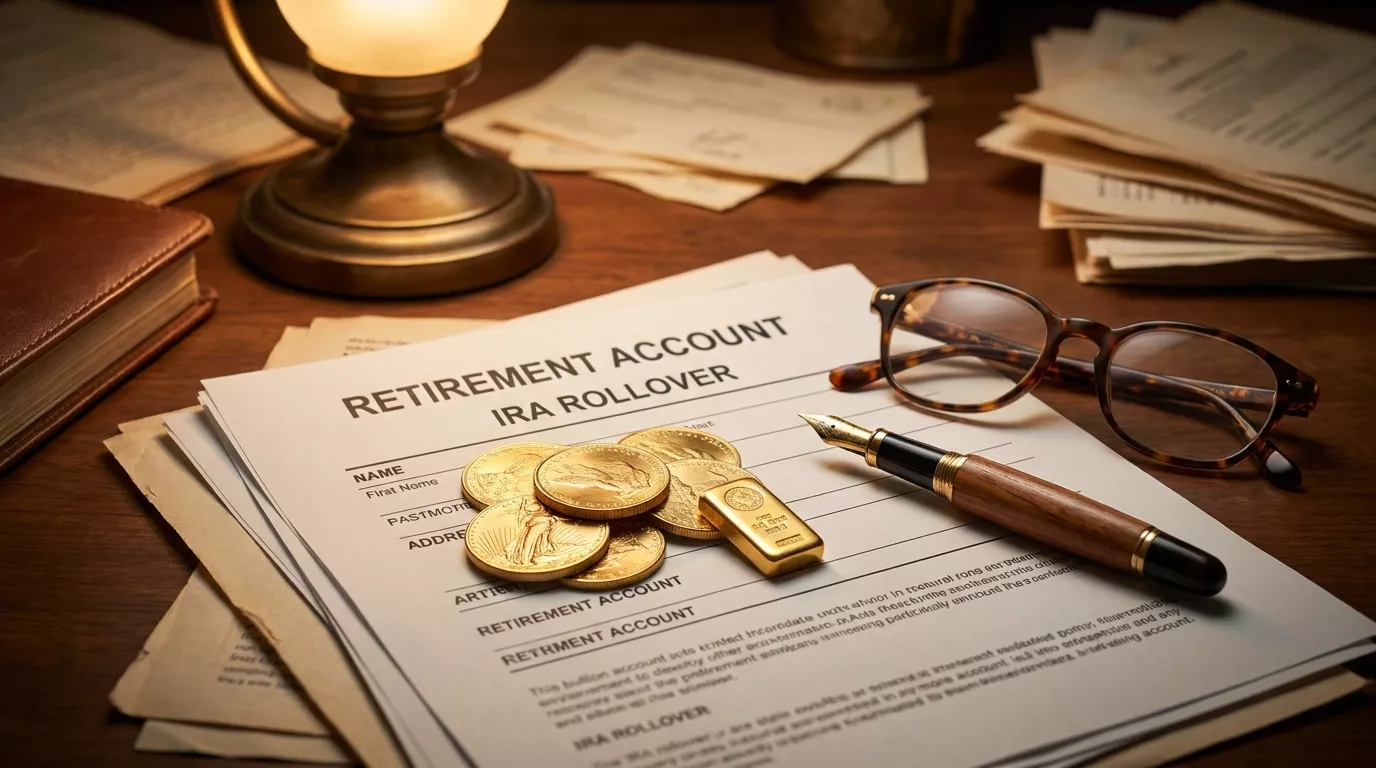
If you have retirement savings sitting in paper assets, you already understand the worry: every year of deficit spending and money-printing quietly chips away at what those dollars can buy. A gold IRA rollover is one way conservative savers move a portion of that nest egg into something Washington can't print into oblivion — IRS-approved physical gold and silver held inside a tax-advantaged retirement account.
The mechanics are more straightforward than the sales pitches make them sound. Here is the honest, step-by-step picture.
What A Gold IRA Actually Is
A gold IRA is a self-directed individual retirement account that holds physical precious metals instead of, or alongside, stocks and bonds. It follows the same contribution limits and tax rules as a conventional IRA. The difference is custody: the metals must be IRS-approved bullion and must be stored in an IRS-approved depository — not in your home safe.
- Same tax treatment you already understand (Traditional or Roth).
- Holds IRS-approved gold, silver, platinum, and palladium bullion.
- Metals are stored in an insured, IRS-approved depository.
- A specialized custodian administers the account paperwork.
Which Accounts Can Be Rolled Over
In most cases, funds from an eligible employer or individual retirement plan can be moved into a gold IRA. That commonly includes:
- Traditional and Roth IRAs
- 401(k) plans from a former employer
- 403(b) and 457(b) plans
- Thrift Savings Plan (TSP) for federal employees and the military
- SEP and SIMPLE IRAs
An active 401(k) with your current employer may have restrictions, so confirm eligibility with your plan administrator first.
Direct Transfer vs. 60-Day Rollover
This is the single most important distinction, and getting it wrong is the most common costly mistake.
Direct (custodian-to-custodian) transfer
The money moves directly between custodians and never touches your hands. This is generally the cleanest path: no taxes withheld, no 60-day clock, and no risk of an accidental early-distribution penalty. Most reputable dealers will steer you here.
60-day (indirect) rollover
Here the funds are paid to you first, and you have 60 days to redeposit them into the new account. Miss the window and the IRS can treat the whole amount as a taxable distribution — plus a 10% penalty if you're under 59½. Whenever possible, prefer a direct transfer to sidestep this entirely.
Rule of thumb: a direct, custodian-to-custodian transfer generally avoids taxes and penalties. Always confirm the specifics with your plan administrator and a licensed tax professional before you move money.
The Rollover, Step By Step
- Open a self-directed IRA with a custodian that supports precious metals.
- Fund it via a direct transfer or rollover from your existing account.
- Select IRS-approved bullion with your dealer (purity and product rules apply).
- The dealer ships the metals to an IRS-approved depository in your account's name.
- You receive statements; the metals stay insured and segregated (if you choose segregated storage).
What It Costs — Approximately
Costs vary by provider, but most patriots see a one-time setup fee, an annual custodian fee, and an annual storage fee. Across the companies we cover, all-in annual fees commonly land in roughly the $200–$300 range (approximate; confirm current figures directly). Separately, dealers earn a markup, or spread, on the metals themselves — always ask for it in writing.
Where To Go From Here
Once you understand the mechanics, the next question is who to work with. Our editorial team ranks established gold IRA companies on fee transparency, custody partners, and track record. Compare them on our company reviews before you commit a dollar.
Frequently Asked Questions
Will a gold IRA rollover trigger taxes?+
A direct, custodian-to-custodian transfer generally moves funds without taxes or penalties because the money never reaches you. An indirect (60-day) rollover can become taxable if you miss the redeposit window. Confirm specifics with a licensed tax professional.
How long does a rollover take?+
Once paperwork is complete, a direct transfer commonly settles in a couple of weeks, though timing depends on how quickly the releasing plan administrator acts. Your custodian and dealer can give a current estimate.
Can I store the metals at home?+
No. IRS rules require precious metals in an IRA to be held by an approved depository. So-called 'home-storage IRA' schemes carry significant tax risk; metals must be stored at an IRS-approved facility.
Not Financial Advice. This content is for general education only and is not financial, tax, legal, or investment advice. Investing in precious metals carries risk, including loss of principal. Consult a licensed professional before making decisions.